
Credit: Shutterstock
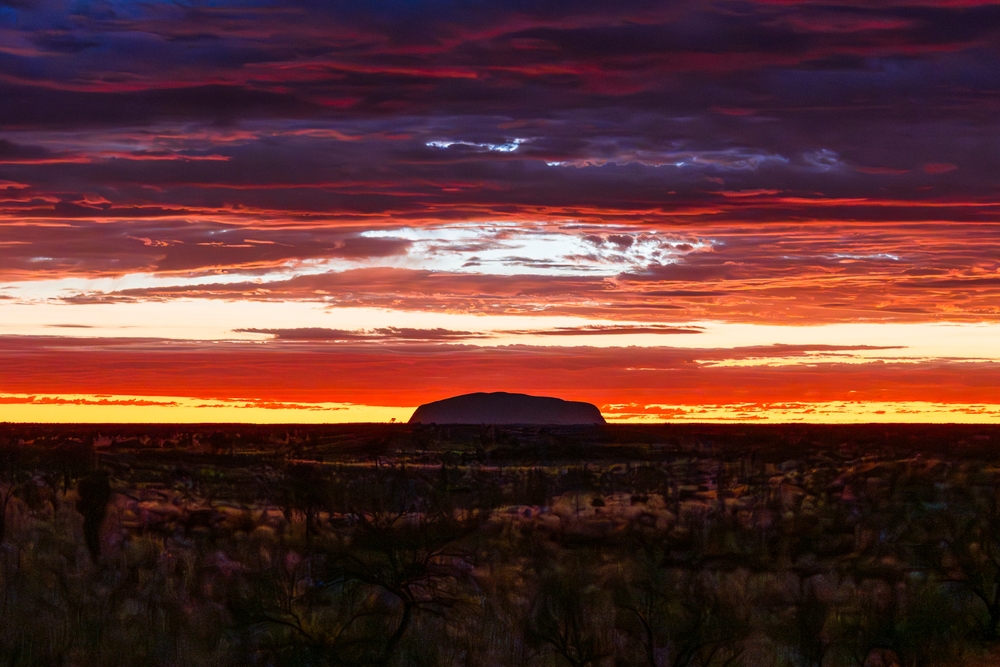
There are plenty of ways to see Uluru, but few can compare with watching Australia’s most iconic landmark slowly rise from the horizon as you walk toward it.
A new multi-day hiking experience in Australia’s Northern Territory is offering travelers exactly that. The Uluru Kakararra Trail takes walkers across 34 miles of striking desert landscapes, beginning near the dramatic rock formations of Kata Tjuta and finishing at the base of Uluru.
The trail officially launched in April and represents the result of roughly a decade of planning and development alongside the Anangu, the traditional Aboriginal custodians of the land. Limited to just 16 guests, the experience is designed to be intimate, low-impact and deeply connected to Country.
Instead of simply arriving at Uluru by road, travelers spend days getting to know the landscape around it — sleeping beneath desert skies, walking through ancient terrain and learning about the cultural significance of the land from Aboriginal guides.
A Different Way to Experience Uluru
Uluru is one of those places that can feel almost too familiar. Its distinctive red silhouette appears on postcards, travel campaigns and countless social media feeds.
But seeing it from a distance and watching it grow larger with every step is an entirely different experience.
From far away, Uluru initially looks surprisingly small against the enormous Australian desert. As the trail progresses, however, the rock becomes an increasingly powerful presence. It disappears behind dunes and desert vegetation before suddenly reappearing, seeming to change personality throughout the day.
The experience encourages travelers to slow down and notice details that can easily be missed from a vehicle.
The Journey Begins at Kata Tjuta
The adventure starts near Kata Tjuta, whose name means “many heads” in Pitjantjatjara. Unlike Uluru’s single imposing form, Kata Tjuta is made up of a collection of rounded peaks, dramatic valleys and narrow gorges.
The opening section of the trail passes through surprisingly diverse scenery. Waterholes, river red gums, grasses and native wildlife reveal that the desert is far from empty.
Birdsong can echo through the rocky passages, while budgerigars and other native species move through the surrounding vegetation.
Along the way, guides explain how the landscape was formed. Kata Tjuta and Uluru are both extraordinarily ancient geological formations, shaped over hundreds of millions of years and dramatically rising above the surrounding plains.
Yet geology is only part of the story.
For the Anangu, these formations and the surrounding landscape have profound cultural and spiritual significance. Stories connected to ancestral beings, traditions and ceremonies are not simply tourist attractions, and some knowledge is intentionally kept within the community.
That makes the journey as much about understanding the limits of what visitors can know as it is about discovering the landscape itself.
Sleeping Beneath the Desert Sky
One of the biggest differences between this experience and a typical Uluru sightseeing trip is the opportunity to stay overnight within the surrounding landscape.
After a day of walking, guests settle into an eco-camp overlooking the desert. Tents, wooden walkways and an off-grid lodge create a comfortable base without overwhelming the natural environment.
Meals are served at camp, while evenings offer something that is increasingly rare in modern travel: genuine darkness and an unobstructed view of the night sky.
There is also the occasional reminder that you’re sleeping in the Australian bush. Native wildlife and insects are part of the experience, adding another layer of authenticity to the adventure.
It is not luxury in the traditional five-star sense. Instead, the luxury comes from space, silence and the feeling of being surrounded by an environment that has remained largely unchanged for generations.
Uluru Changes With Every Hour
After several days on the trail, Uluru gradually becomes more prominent.
The changing light makes the monolith seem almost alive. Before sunrise, its enormous form can appear dark against the sky. As daylight arrives, subtle purples and deeper shades begin to emerge before the famous red tones become more intense.
The colors continue shifting throughout the day, depending on the position of the sun, clouds and surrounding light.
Walking toward the rock makes these changes especially memorable because there is no rush. Travelers are not simply stopping at a lookout for a photograph before moving on. They are watching Uluru transform while the desert unfolds around them.
The Desert Is Anything But Empty
One of the most surprising aspects of the walk is how much life exists across the seemingly barren landscape.
The trail passes through eucalyptus woodland, spinifex grasslands and areas filled with desert oaks. Brown falcons can be seen circling overhead, while reptiles leave winding tracks across the sand.
At walking speed, tiny details become impossible to ignore.
Plants that might blur past the window of a tour vehicle suddenly become part of the scenery. Animal tracks appear in the dunes. Wind moves through the grasses. The sound of birds breaks the quiet.
The journey offers a reminder that the Australian Outback is not a vast empty space. It is a complex ecosystem adapted to one of the country’s harshest environments.
Learning What “Country” Really Means
The cultural element of the Uluru Kakararra Trail is central to the experience.
Aboriginal Australian concepts of Country go far beyond the modern idea of a piece of land or geographical location. Country can encompass relationships between people, landscape, ancestry, culture, plants, animals and traditional knowledge.
Aboriginal guide Tjiangu Thomas, known as TJ, helps visitors understand how these connections have been maintained — and how some have been disrupted over time.
Modern transportation and changing lifestyles have made it easier to travel through the desert without necessarily developing the intimate knowledge of the landscape that earlier generations depended upon.
For the Anangu, reconnecting with Country can therefore be about much more than tourism. It can help preserve cultural knowledge and strengthen relationships with places that hold generations of meaning.
For visitors, the lesson is simple but powerful: walking through a landscape does not necessarily mean understanding it.
Arriving at Uluru
The final stretch of the trail is particularly striking.
The route moves through mulga woodland before gradually opening up. Then Uluru appears above the trees, its red rock faces growing larger as the trail approaches.
Tiny birds move around the cliffs, while the immense scale of the monolith becomes increasingly difficult to comprehend.
Eventually, walkers reach the base.
After days of crossing open desert, the arrival feels almost like entering a sanctuary. Waterholes and shaded areas offer a dramatic contrast to the dry expanses behind you.
It is also a moment for reflection.
Uluru’s climbing route was permanently closed in 2019 after years of discussion about the cultural significance of the rock and the wishes of its traditional owners. For the Anangu, climbing Uluru was deeply disrespectful, and the closure represented an important recognition of its sacred status.
Today, visitors are encouraged to experience Uluru without leaving their own physical mark on it.
A Trail With a Bigger Purpose
The Uluru Kakararra Trail is more than another adventure route added to Australia’s growing collection of hiking experiences.
Its development reflects an effort to create tourism that gives travelers access to an extraordinary landscape while placing Anangu culture and environmental responsibility at the center of the journey.
The small group size helps keep the experience personal, while the use of camps and guided walking reduces the sense of mass tourism that can surround famous landmarks.
Perhaps most importantly, the trail changes the relationship between traveler and destination.
Instead of arriving at Uluru and immediately taking a photograph, you spend several days earning the view.
By the time the rock finally towers above you, it is no longer simply the famous landmark you’ve seen in countless photographs. It has become the destination at the end of a journey through desert, history, culture and Country.
And that may be the most memorable souvenir of all.
How to Experience the Uluru Kakararra Trail
The Australian Walking Company is the exclusive operator of the Uluru Kakararra Trail, so independent hiking of the route is not currently available.
Its five-day Uluru-Kata Tjuta Signature Walk includes guided walking, accommodation, meals and time to relax at eco-camps before the final portion of the experience at a bush lodge overlooking Uluru.
Prices start at around A$5,395 per person, with departures generally scheduled between April and September, when conditions are more suitable for extended desert walking.
Travelers can reach the region through Ayers Rock Airport, which has flights from major Australian cities including Sydney and Melbourne.
For anyone looking for a slower, more meaningful way to experience the Red Centre, this new trail offers something a traditional sightseeing trip simply cannot: the chance to walk toward Uluru, rather than merely arrive at it.