
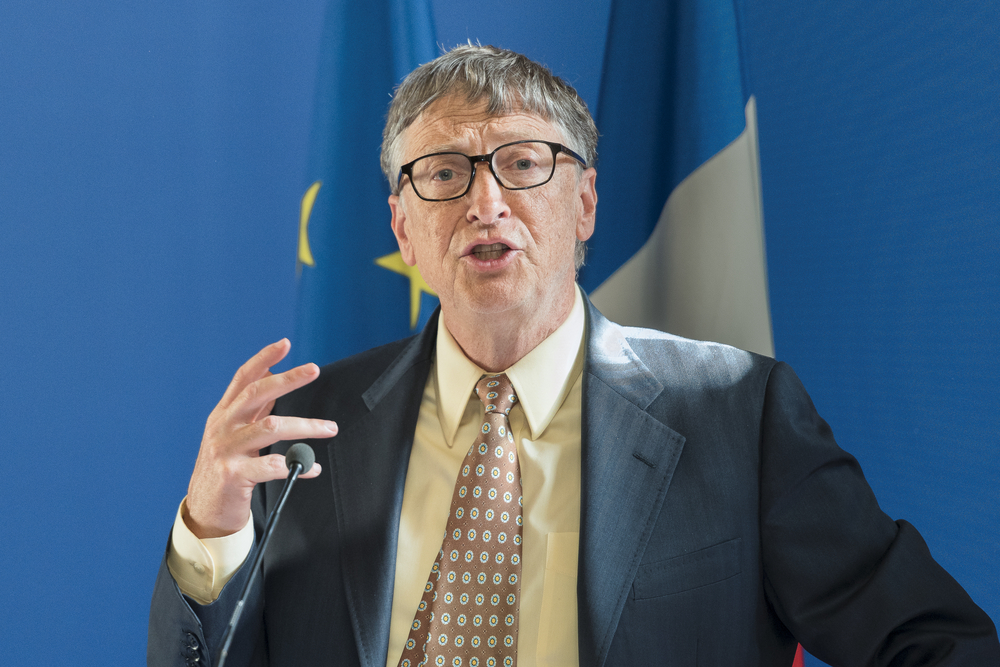
Credit: Shutterstock
Artificial intelligence has been hailed as one of the most transformative technologies of the modern era, but Microsoft co-founder Bill Gates is warning that its darker possibilities deserve serious attention before the technology advances even further.
During an appearance on NBC’s Meet the Press, Gates raised the possibility of an AI-enabled catastrophe on an extraordinary scale, saying advanced artificial intelligence could be powerful enough to contribute to events resulting in a billion deaths if combined with malicious intent.
The warning wasn’t that AI itself is destined to cause such a disaster. Instead, Gates focused on what could happen when increasingly capable AI systems are placed in the hands of people attempting to cause harm.
The Dangerous Line Between Medicine and Misuse
One of Gates’ biggest concerns is the difficulty of separating beneficial scientific research from work that could potentially be exploited for destructive purposes.
AI systems can assist researchers with complex biological and medical questions, potentially helping accelerate the development of new treatments and medicines. But the same capabilities, Gates cautioned, could potentially be misused by individuals attempting to develop biological weapons.
“I wish it was easier to distinguish good intent,” Gates said during the interview, contrasting legitimate drug development with attempts to create tools for bioterrorism.
That blurred line, he argued, makes oversight increasingly important.
Gates Calls for Stronger AI Monitoring
Rather than simply calling for an end to AI development, Gates emphasized the need for safeguards around the most sophisticated systems.
He argued that advanced AI models should be monitored and that there should be clear records of how they are being used. In his view, establishing stronger oversight would not necessarily require the technology industry to slam the brakes on innovation.
Gates also suggested that the United States should take a leading role in creating standards for advanced AI, while acknowledging that other major powers, including China, are likely to pursue their own approaches.
The broader message was strikingly simple: AI development and AI safety do not have to be treated as opposing goals.
The AI Safety Debate Is Getting Louder
Gates’ comments arrive as concerns about the potential misuse of artificial intelligence continue to attract attention from technology researchers, policymakers and industry leaders.
Anthropic has recently reported disrupting attempts to use its AI systems for research that could potentially contribute to biological-weapons development. The company said it could not always determine whether particular biological research had legitimate or malicious intentions, highlighting precisely the problem Gates described.
The debate has also expanded beyond technology companies. Public officials and political figures have offered sharply different views on how aggressively AI should be regulated, with some emphasizing the need to maintain rapid development and international competitiveness while others have called for stronger safeguards.
A Warning, Not a Prediction
Perhaps the most important distinction in Gates’ comments is that the billion-death figure was presented as a potential consequence of an extreme scenario, not as a forecast that one billion people will actually die because of AI.
His argument centers on the unprecedented combination of increasingly powerful technology and malicious human intent.
As AI systems become more capable, the question may no longer be simply what the technology can do. It could increasingly become a question of who is using it, why they are using it and how closely those uses can be monitored.
For Gates, that is precisely why governments and technology companies need to establish safeguards while there is still time to shape how advanced AI is deployed.
The warning may sound dramatic, but it points to a much broader conversation now unfolding around artificial intelligence: how humanity can pursue the enormous benefits of the technology without allowing its most dangerous capabilities to become tools for catastrophic harm.