
Credit: Shutterstock
Even if your next trip isn’t headed to the Middle East, the unfolding conflict in Iran could ripple through the skies in ways you might not expect. Flights are already feeling the impact as airlines scramble to avoid unsafe airspace, leaving travelers with potential delays, longer routes, and higher ticket prices.
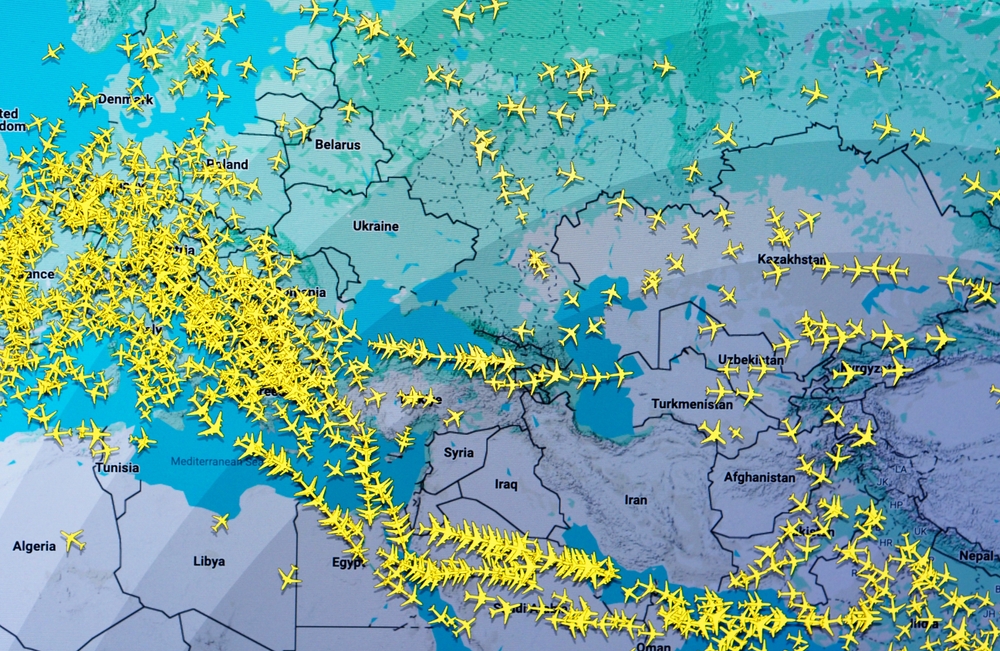
The effect is dramatic. According to aviation tracking data analyzed by USA TODAY, passenger flights in the Middle East plummeted from over 13,000 on February 28 to roughly 800 by March 1. Major hubs like Dubai, Doha, and Abu Dhabi have seen entire flight schedules vanish almost overnight. Dubai International Airport, one of the busiest airports in the world, went from 1,500 flights to zero, while Doha’s Hamad International Airport also reported a complete halt in operations.
Suzanne Morrow, CEO of InsureMyTrip, warns travelers connecting through these hubs to anticipate continued disruption. She recommends checking with your airline for updates, reviewing rebooking policies, and keeping all receipts if you plan to use travel insurance. The U.S. State Department is also urging Americans in the Middle East to consider leaving the region promptly and to sign up for its STEP program for real-time travel alerts.
Even if your trip doesn’t pass through the Middle East, geopolitical events can still reshape your journey. Flights to Asia, for example, are rerouted around Russian airspace due to the ongoing Russia-Ukraine conflict, adding hours to travel time and increasing costs. Bijan Vasigh, a professor of air transportation at Embry-Riddle Aeronautical University, points out that while detours are inconvenient, they prioritize passenger safety. History underscores this need for caution: Malaysia Airlines Flight 17 was tragically shot down over Ukraine in 2014, and an Azerbaijan Airlines flight was downed in Kazakhstan in 2024.
Airlines constantly monitor global risks, and the closure of airspace in conflict zones is more common than many travelers realize. “Safety, orderly operations, and expeditious movement of traffic are the FAA’s priorities,” says Mark Dombroff, cochair of the aviation practice at law firm Fox Rothschild. When sudden conflicts erupt, flights may be diverted, schedules adjusted, and evacuation flights occasionally launched for stranded citizens.
Despite the disruptions, these challenges aren’t permanent. Airspace closures are regulatory, not physical, and can reopen as situations stabilize. Dombroff notes that airlines are usually quick to resume the most efficient routes when it’s safe. For passengers, staying informed is key—monitor airline communications, check your travel insurance options, and prepare for changes.
Passenger rights can vary. Airlines are generally not obligated to compensate travelers when conflicts disrupt flights, but they do usually offer alternatives. Refunds are possible if offered alternatives are declined, according to Department of Transportation rules. Travel insurance with “cancel for any reason” coverage can provide extra protection for geopolitical uncertainties, though it’s important to purchase these add-ons shortly after booking.
In short, global conflicts like the Iran war can touch your trip even if you’re nowhere near the region. Staying proactive, flexible, and informed is your best strategy for navigating an increasingly unpredictable sky.