Credit: Shutterstock
Yoga can look intimidating when you see people effortlessly twisting into impressive poses, but you really don’t need to be flexible or experienced to get started. Some of the most useful yoga poses are simple enough for beginners and can be practiced at home with little more than a comfortable surface.
Yoga combines movement, breathing, balance, and mindful attention. As you move through each pose, try to breathe slowly and avoid rushing from one position to the next. For many beginner poses, starting with around 10 seconds is a comfortable goal. As you become more familiar with the movements, you can gradually stay longer.
Here are 10 beginner-friendly yoga poses to add to your routine.
1. Downward-Facing Dog
Downward-Facing Dog is one of yoga’s most recognizable poses. It gives the backs of your legs, shoulders, and upper back a gentle stretch while also asking your arms and core to work.
How to do it:
- Start on your hands and knees with your hands beneath your shoulders.
- Tuck your toes under and slowly lift your hips toward the ceiling.
- Straighten your legs as much as feels comfortable without forcing your heels down.
- Keep your hands firmly planted and lengthen your spine.
- You can gently bend one knee at a time to loosen your legs.
- Breathe slowly and hold for about 10 seconds to start.
Don’t worry if your heels don’t touch the floor. That’s completely normal, especially when you’re new to yoga.
2. Mountain Pose
Mountain Pose may look like you’re simply standing still, but it encourages good posture, body awareness, and steady breathing. It’s also a great reset between more active poses.
How to do it:
- Stand tall with your feet comfortably together or slightly apart.
- Let your arms rest naturally beside you.
- Distribute your weight evenly across both feet.
- Relax your shoulders and gently lengthen your spine.
- Take a slow breath through your nose and exhale comfortably.
- Stay here for about 10 seconds or several slow breaths.
Think of this pose as your chance to pause, reset, and reconnect with your breathing.
3. Warrior I
Warrior I introduces beginners to a stronger standing pose. It works the legs while challenging your balance and stability.
How to do it:
- Stand tall and step one foot forward into a comfortable lunge.
- Turn the back foot slightly outward for support.
- Bend your front knee while keeping it aligned comfortably over your foot.
- Square your hips as much as you comfortably can toward the front.
- Reach both arms overhead without shrugging your shoulders.
- Take several slow breaths before switching sides.
Keep the stance comfortable rather than trying to create the deepest possible lunge.
4. Warrior II
Warrior II is another classic standing pose that brings the legs, core, and arms into the movement. It can also help beginners practice balance and body awareness.
How to do it:
- Start in a wide stance with your front foot pointing forward.
- Turn your back foot slightly outward.
- Bend your front knee while keeping the back leg strong.
- Extend your arms straight out at shoulder height.
- Keep your shoulders relaxed and your chest open.
- Look forward over your front hand and breathe steadily.
- Hold for around 10 seconds, then repeat on the other side.
If your front leg begins to shake, that’s a good reason to straighten it slightly and take a break.
5. Triangle Pose
Triangle Pose can feel a little more challenging, but beginners can make it much easier by using a yoga block or placing their hand higher on their leg instead of reaching for the floor.
How to do it:
- Take a wide stance with one foot pointing forward and the other turned slightly outward.
- Extend your arms to the sides.
- Gently lean your torso toward your front leg.
- Place your lower hand on your shin, thigh, or a yoga block.
- Reach your opposite arm toward the ceiling.
- Keep your chest open and take several comfortable breaths.
- Repeat on the opposite side.
Never force yourself to reach the floor. The goal is controlled movement, not maximum flexibility.
6. Cat-Cow
Cat-Cow is a gentle, flowing movement rather than a static pose. It’s particularly useful as a warm-up because it encourages comfortable movement through the spine.
How to do it:
- Begin on all fours with your hands beneath your shoulders and knees beneath your hips.
- As you inhale, gently lift your chest and tailbone while allowing your spine to curve.
- As you exhale, gently round your back and draw your chin toward your chest.
- Move slowly between the two positions.
- Continue for several controlled breaths.
There’s no need to make the movement dramatic. Focus on smooth, comfortable motion.
7. Child’s Pose
When you need a breather during a yoga session, Child’s Pose is a wonderful place to slow down. It gently stretches the back while giving your body a chance to relax.
How to do it:
- Begin on your hands and knees.
- Slowly sit your hips back toward your heels.
- Extend your arms forward or let them rest alongside your body.
- Lower your forehead toward the mat if that’s comfortable.
- Take slow, relaxed breaths.
- Stay for 10 seconds or longer if the position feels comfortable.
If your hips don’t comfortably reach your heels, place a cushion or folded blanket underneath you for support.
8. Tree Pose
Tree Pose is a simple way to introduce balance work into your routine. Don’t worry if you wobble or need to put your foot down—that’s part of learning.
How to do it:
- Stand tall with your feet together or comfortably apart.
- Shift your weight onto one foot.
- Place the sole of your other foot against your inner calf or thigh.
- Avoid placing your foot directly against the side of your knee.
- Bring your hands together at your chest or reach them overhead.
- Pick a stationary point in front of you to help with balance.
- Hold for several breaths before changing sides.
For extra stability, practice beside a wall or keep your lifted toes lightly touching the floor.
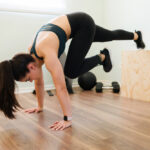
9. High Plank
High Plank is a beginner-friendly strength-building pose that engages your core, shoulders, arms, and legs. You don’t need to hold it for a long time to feel the challenge.
How to do it:
- Start on all fours.
- Step one foot back at a time until your body forms a long line.
- Place your hands directly beneath or close to beneath your shoulders.
- Keep your head in a neutral position.
- Engage your core and avoid letting your lower back sag.
- Hold for a few steady breaths, gradually working toward 10 seconds.
If a full plank feels too difficult, practice with your knees on the floor while maintaining a straight line from your head through your hips.
10. Cobra Pose
Cobra Pose gently introduces spinal extension and can open the front of the body. The key for beginners is to keep the movement controlled rather than trying to lift as high as possible.
How to do it:
- Lie on your stomach with your legs extended behind you.
- Place your palms near your ribs and keep your elbows close to your body.
- Gently press into your hands as you lift your chest.
- Keep your shoulders away from your ears.
- Only lift as far as feels comfortable.
- Keep your movement controlled and breathe naturally.
- Hold for several seconds before slowly lowering down.
Your hands don’t need to do all the work. Think about creating length through your spine rather than pushing yourself into a deep backbend.
How to Make Your Beginner Yoga Practice Easier
You don’t need a complicated routine to benefit from yoga. Start with a few poses that feel comfortable and gradually build from there.
A simple beginner session could include Mountain Pose, Cat-Cow, Downward-Facing Dog, Warrior I, Warrior II, Child’s Pose, and Cobra Pose. You can add Tree Pose, Triangle Pose, and High Plank as your confidence improves.
Most importantly, don’t treat flexibility as a requirement. Yoga is not a competition, and your version of a pose may look completely different from someone else’s.
Let Your Breathing Set the Pace
One of the simplest ways to make yoga feel more approachable is to connect your breathing with your movements. Take slow, comfortable breaths and avoid holding your breath while you’re concentrating on a difficult pose.
You should generally feel stretching or muscular effort, but sharp pain is a signal to stop or ease out of the position. Beginners may also benefit from using props such as blocks, cushions, or straps to make poses more comfortable.
With regular practice, these basic poses can become the foundation of a relaxing routine that helps you work on balance, mobility, strength, body awareness, and mindful breathing—one comfortable breath at a time.