
Credit: Shutterstock
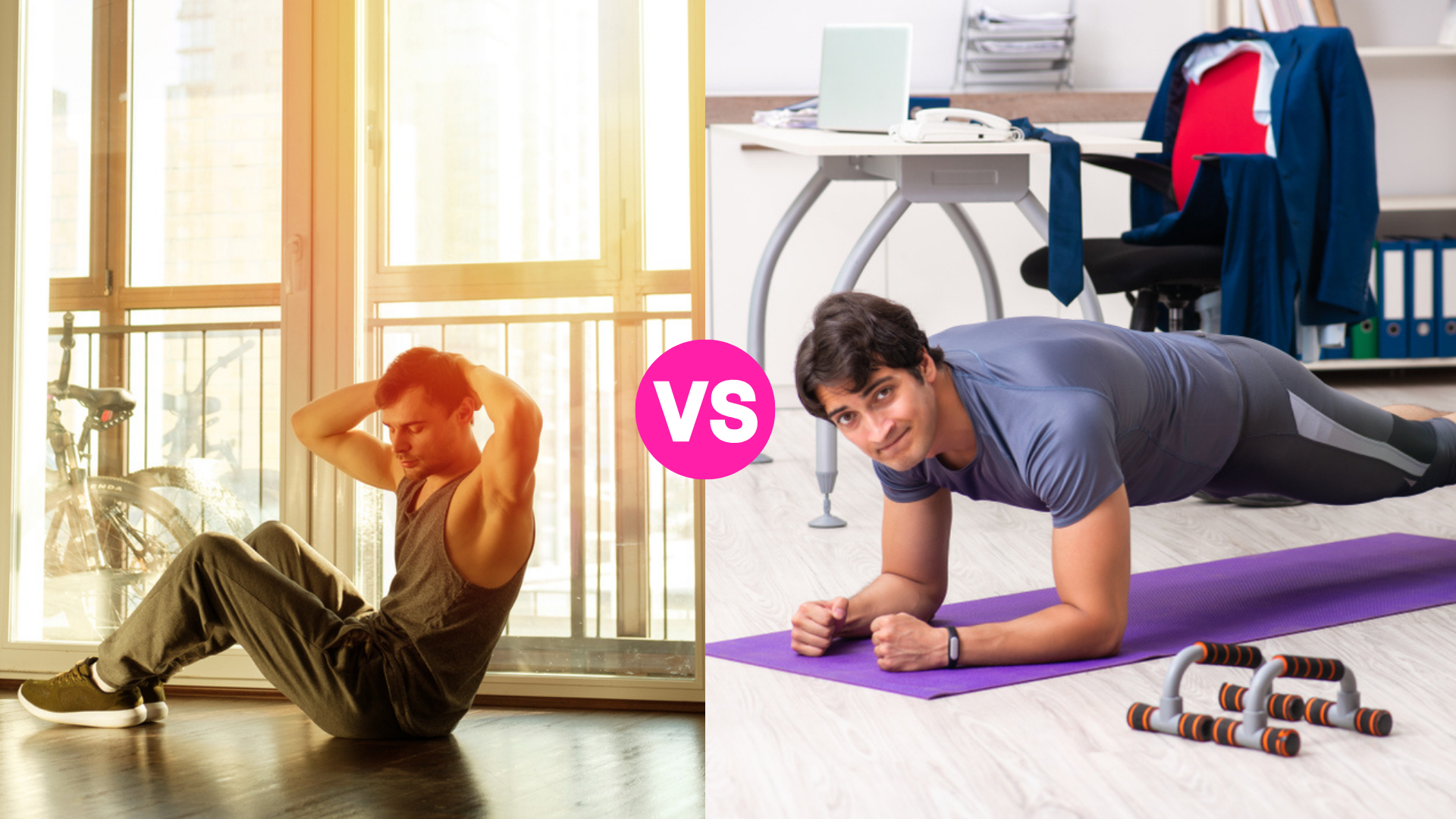
Crunches and planks are two of the most well-known exercises that come to mind when you think of core exercises. They are easy to use, efficient, and don’t require any expensive equipment. They can be performed on the floor of your living room, in a park, or even during a commercial break. Which one should you pick, though, if you want to have sculpted abs and a stronger core?
Building True Core Strength
Planks are the best option if strength is your main concern. Planks are a static hold; no movement is necessary, in contrast to crunches. All you’re doing is keeping your body in a straight line and using your shoulders, legs, glutes, and core to fight gravity.
Your transverse abdominis, the deepest layer of your core muscles and the one that provides true stability and strength from the inside out, is activated by this full-body tension. According to Noam Tamir, CSCS, founder of TS Fitness in New York City, “planks engage your core in a 360-degree way.” To put it another way, you’re strengthening your abs to support all of your movements, from running up stairs to lifting groceries.
Bonus: Better posture, less lower back pain, and improved athletic performance are all possible with stronger deep-core muscles.
Sculpting Visible Ab Definition
Crunches still have a place if your primary goal is visible definition, like those six-pack lines. The surface muscle group responsible for the “six-pack” appearance, the rectus abdominis, is the main target of crunches.
According to Or Artzi, CPT, founder of Orriors and lead instructor at Equinox, “repeated spinal flexion puts direct tension on the rectus abdominis, encouraging muscle growth.” Adding resistance, such as holding a dumbbell or plate on your chest while performing crunches, can improve the results even further.
But it’s important to keep in mind that if your abs are covered in fat, no amount of crunches will show them off. Nutrition is important; consider lean proteins, lots of vegetables, and portions that are balanced.
Why You Need Both?
The true secret is that you don’t need to take sides. While crunches create definition on the surface, planks provide the foundation’s deep, stabilizing strength. They are the ideal power couple for your core when combined.
If neither is uncomfortable, Artzi suggests incorporating both into your weekly routine. Begin with simple forms:
For crunches, lie flat on your back with your feet flat and your knees bent. Put your hands behind your head or cross your arms over your chest. Without jerking or pulling your neck, raise your shoulders off the floor by using your core.
Planks: Make a straight line from your shoulders to your heels starting on your hands and toes. Keep your hips level and your abs tight.
You can advance by trying side planks, walking planks, or weighted planks for an added challenge after you’ve mastered these fundamentals. To work your abs from different perspectives, try stability ball crunches, decline crunches, or captain’s chair variations.
For deep core strength and stability, planks are the go-to exercise. When it comes to creating noticeable ab definition, crunches are excellent. Combining the two, along with a healthy diet, will help you strengthen and style your core.
Therefore, don’t just pick one the next time you hit the mat. Crunching it out and holding strong alternate. With power and polish, your abs will appreciate it.